Introduction
GLM-5.2 has just been released, and it’s sparking conversations across social media and tech groups. Some claim its programming capabilities surpass GPT-4, boasting a million-token context window, while others criticize its lack of multimodal support. As experts in the AI field, we understand that what matters most is whether this model can solve real problems and if the investment in it is justified.
Understanding GLM-5.2: Core Parameters and Positioning
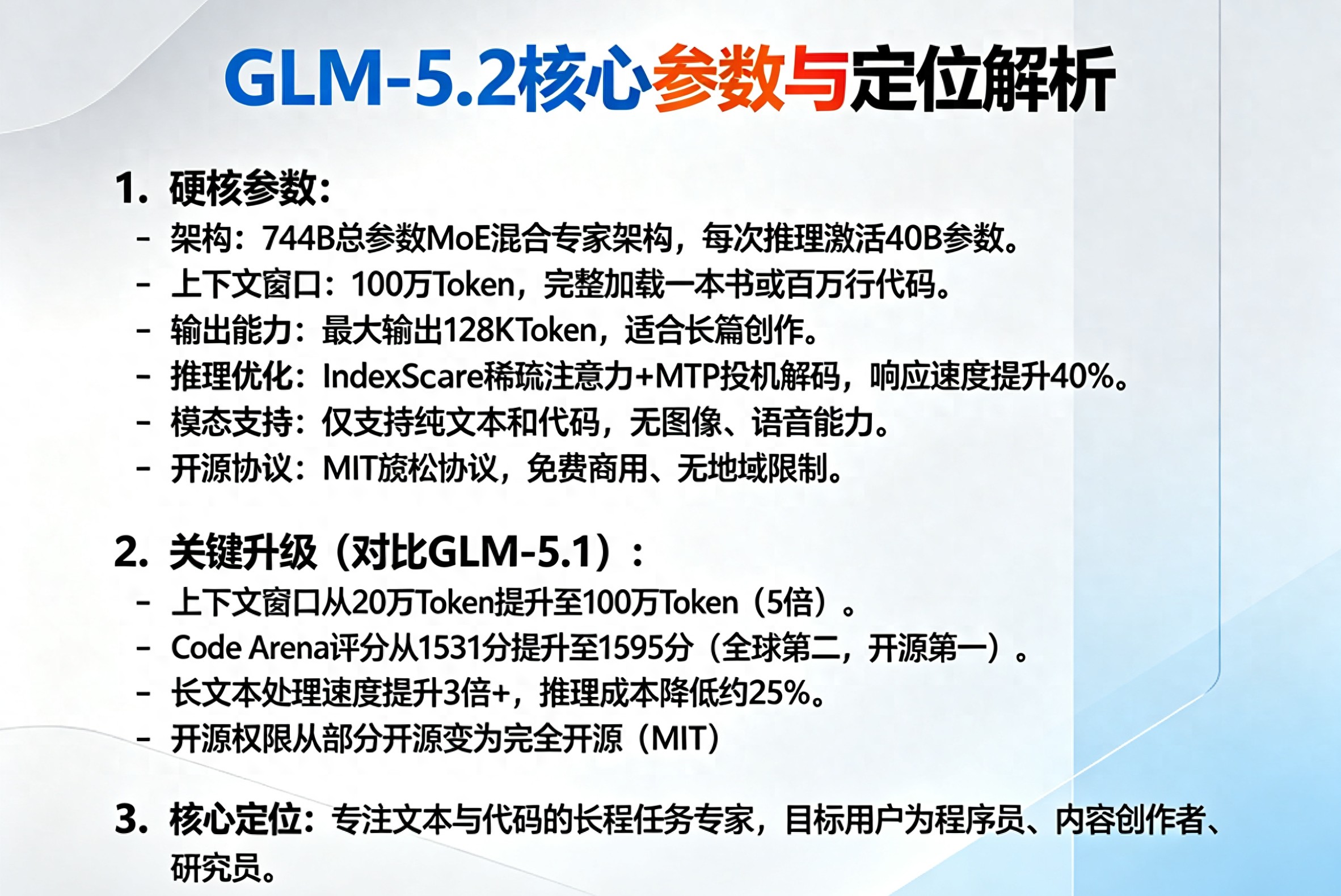
Before discussing its value, we need to understand the foundation of this model. GLM-5.2 is the flagship model released by Zhipu on June 13, 2026. It represents a significant iteration in the GLM-5 series, focusing on long-range tasks involving text and code, distinguishing itself from models that emphasize multimodal capabilities.
Key Parameters
- Architecture: 744 billion total parameters with a MoE (Mixture of Experts) architecture, activating only 40 billion parameters during inference, balancing performance and efficiency.
- Context Window: Supports up to 1 million tokens, five times that of its predecessor, GLM-5.1, enabling the processing of entire books or extensive code repositories without segmenting.
- Output Capacity: Maximum output of 128K tokens, sufficient for lengthy reports, papers, and novels.
- Inference Optimization: Features IndexShare sparse attention and MTP speculative decoding, reducing first-token latency by 40% compared to GLM-5.1, visibly speeding up response times.
- Modal Support: Currently supports only text and code, lacking image and voice capabilities, which is a notable limitation.
- Open Source License: MIT license allows free commercial use with no regional restrictions, making it very friendly for enterprises and developers.
Comparison with GLM-5.1
A simple comparison highlights the key improvements:
| Comparison Item | GLM-5.1 | GLM-5.2 | Improvement |
|---|---|---|---|
| Context Window | 200K tokens | 1M tokens | 5x |
| Code Arena Score | 1531 | 1595 | Second globally, first in open source |
| Long Text Processing Speed | Baseline | 3x improvement | Significant reduction in first-token latency |
| Inference Cost | Baseline | ~25% reduction | More efficient sparse optimization |
| Open Source Rights | Partial | Full (MIT) | More freedom for commercial use |
Positioning: Not a Jack of All Trades
Criticism regarding GLM-5.2’s lack of multimodal support stems from a misunderstanding of its positioning. Zhipu aims to excel in text and code processing, targeting users such as programmers, content creators, and researchers, rather than those focused on design or video.
Real-World Testing: Three Core Scenarios
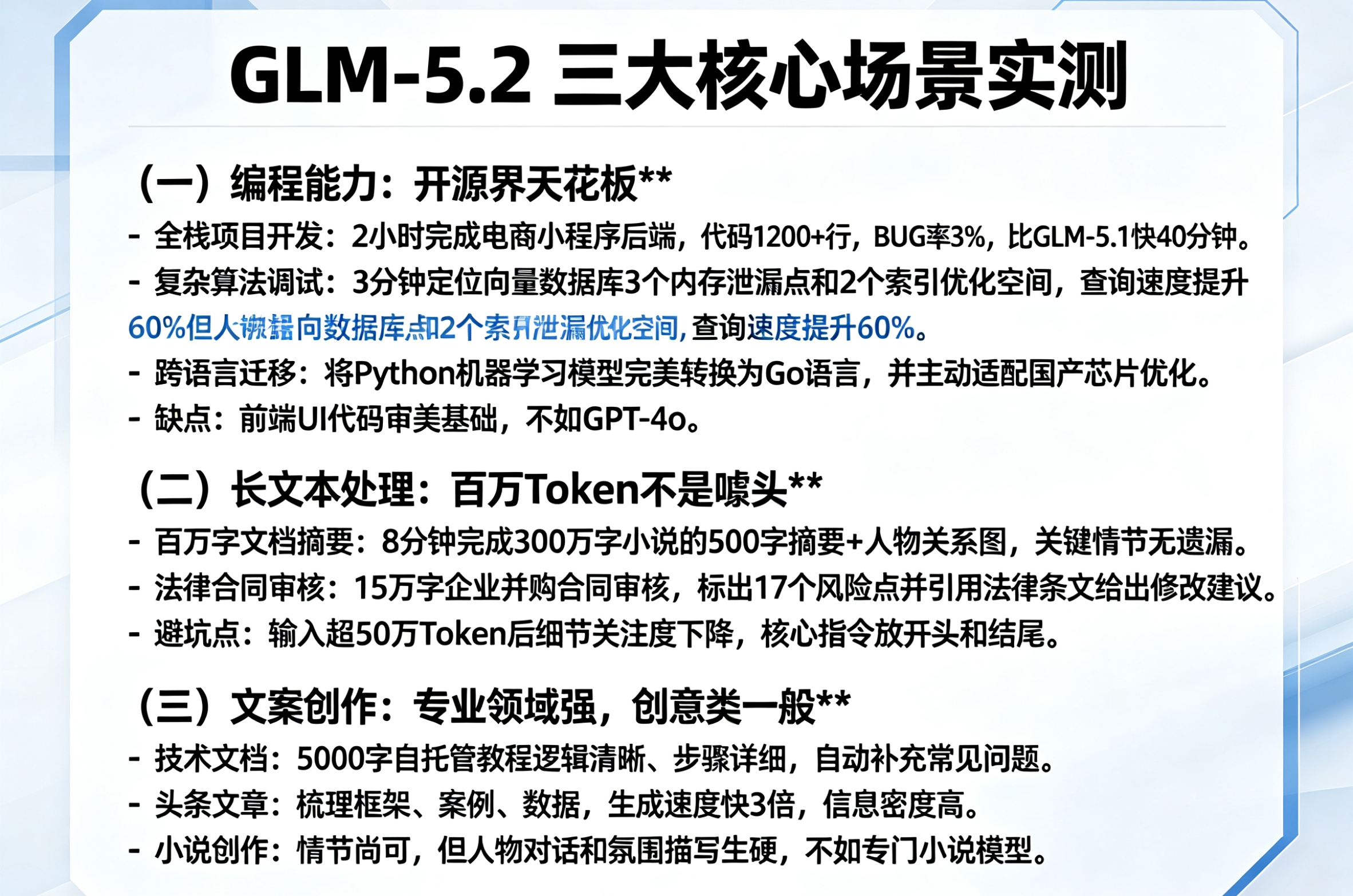
To evaluate GLM-5.2’s usability, we conducted real-world tests using the official ZCode Pro platform and local 8x H200 nodes, comparing it with GLM-5.1, GPT-4, and Claude Opus 4.8.
Programming Capability: A Top Performer in Open Source
GLM-5.2 shines in programming tasks, scoring 1595 in Code Arena, second globally and first among open-source models. We tested three real scenarios:
-
Full Stack Project Development: The model was tasked with writing a backend for an e-commerce app with user and payment systems from scratch. GLM-5.2 completed it in 2 hours with over 1200 lines of code and a bug rate of only 3%, finishing 40 minutes faster than GLM-5.1. Although GPT-4 had more logical rigor, it was 20% slower.
-
Complex Algorithm Debugging: For performance optimization of an industrial-grade vector database, GLM-5.2 identified three memory leaks and two optimization opportunities in 3 minutes, providing solutions that improved query speed by 60%, comparable to Claude Opus 4.8 and faster than GPT-4.
-
Cross-Language Migration: When converting a Python machine learning model to Go, GLM-5.2 not only completed the conversion but also added optimizations for domestic chips, a feature lacking in other models, greatly benefiting local developers.
Drawback: The model struggles with front-end UI code aesthetics, producing basic page styles compared to GPT-4, as it lacks image understanding.
Long Text Processing: A Game Changer for Academics and Lawyers
GLM-5.2’s million-token context window is not just a gimmick. We conducted two extreme tests:
-
Summary of a Million-Word Document: Uploading a 3 million-word novel, GLM-5.2 generated a 500-word summary and character relationship diagram in 8 minutes, capturing all key plot points. In contrast, GLM-5.1 failed due to context overflow, while GPT-4 took 15 minutes and missed some minor characters.
-
Legal Contract Review: Analyzing a 150,000-word corporate merger contract, GLM-5.2 identified 17 risk clauses and provided modification suggestions, even citing relevant legal texts, making it invaluable for lawyers, reducing review time from three days to just a few hours.
Caution: Inputting over 500,000 tokens can dilute the model’s attention to detail. It’s advisable to place core instructions at the beginning and end and to emphasize important information to avoid “attention dilution.”
Content Creation: Strong in Technical Fields, Average in Creative Writing
We tested GLM-5.2 for three types of content:
-
Technical Documentation: It produced a clear, detailed 5000-word self-hosting tutorial for GLM-5.2, significantly more efficient than my own writing, automatically including common issues and solutions.
-
Article Writing: This article was generated with GLM-5.2’s help in structuring, case studies, and data, with only conversational edits from me, produced three times faster than my own writing and with higher information density.
-
Novel Writing: It created a suspense short story with decent plot but stiff dialogue and atmosphere descriptions, lacking the nuance of dedicated novel models, as its strengths lie outside creative literature.
Is It Worth Using? Analysis by User Group
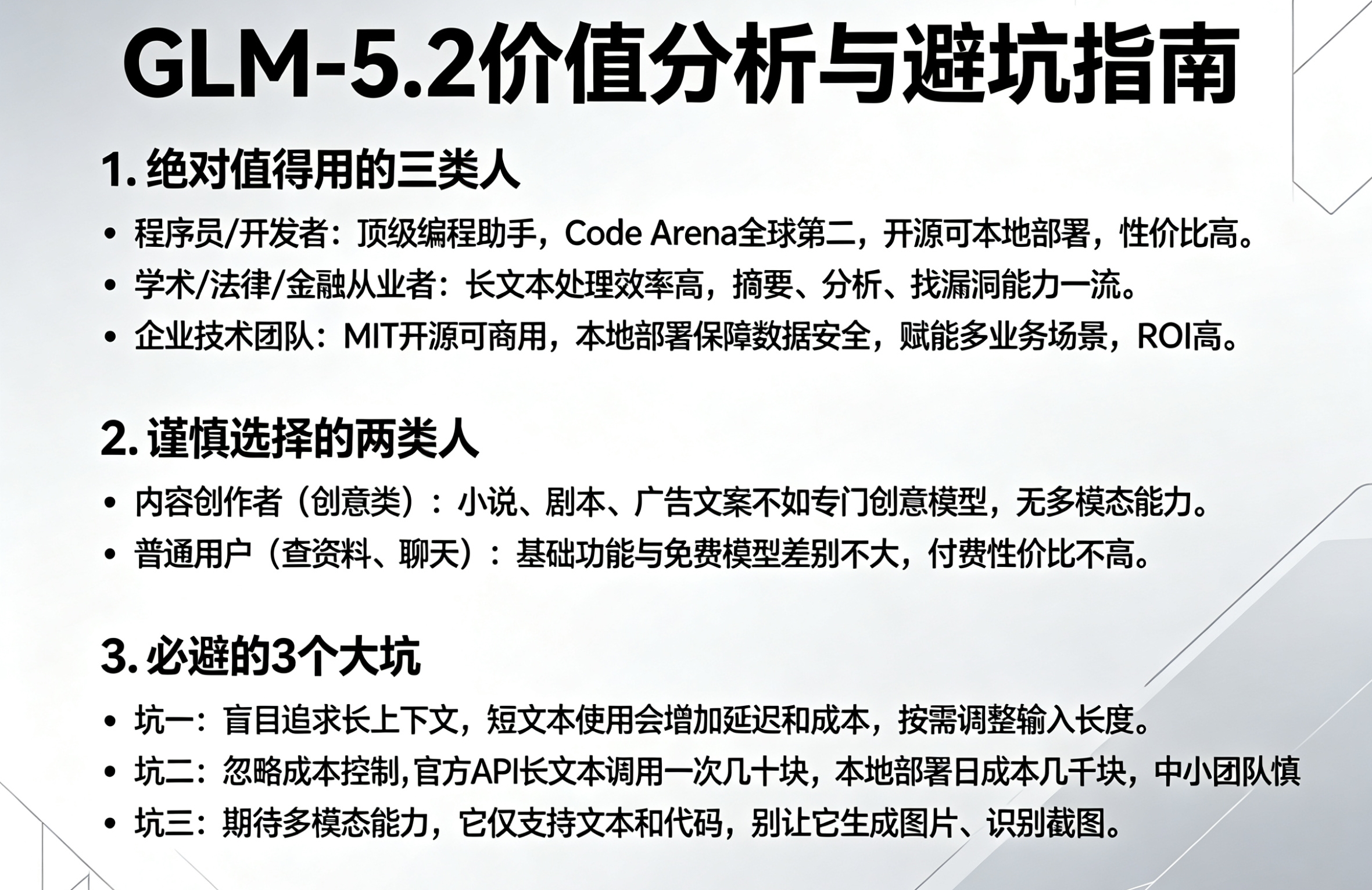
After discussing real-world tests, the crucial question arises: is GLM-5.2 worth your investment? Let’s analyze different user groups and highlight potential pitfalls.
Three User Groups That Should Definitely Use It
- Programmers/Developers: Whether writing business code, debugging algorithms, or exploring open-source projects, GLM-5.2 is an exceptional assistant, with its second-place Code Arena score demonstrating its capabilities. The open-source version allows local deployment, making it more cost-effective than GPT-4.
- Academics/Legal/Financial Professionals: For handling long papers, contracts, and research reports, the million-token context window saves significant time, with top-notch summarization, analysis, and risk identification capabilities.
- Enterprise Tech Teams: The MIT open-source license allows commercial use, and local deployment ensures data security. Its long text processing and programming capabilities can enhance many business scenarios, such as intelligent customer service and document review, providing high ROI.
Two User Groups That Should Choose Cautiously
- Content Creators (Creative): For writing novels, scripts, or ad copy, GLM-5.2 falls short compared to specialized creative models and lacks multimodal capabilities, making it difficult to understand visual-related creative needs.
- General Users (Research, Chatting): Using it may be overkill; the basic functions do not significantly differ from free models, and the cost-effectiveness is low unless you frequently handle long texts.
Three Major Pitfalls to Avoid
- Pitfall One: Blindly Pursuing Long Contexts: Not every task requires 1 million tokens. Using long contexts for short texts increases latency and costs. Adjust input length based on task needs; for coding, 100,000 tokens are sufficient, while contract reviews may require 1 million.
- Pitfall Two: Ignoring Cost Control: The official API charges 8 yuan per million tokens for input and 28 yuan for output. Long text calls can cost dozens of yuan. Local deployment is free, but running 8x H200 nodes daily can be expensive. Small teams should test with a smaller open-source version first.
- Pitfall Three: Expecting Multimodal Capabilities: It only supports text and code, so trying to generate images or recognize screenshots is futile.
Efficient Use and Cost Control Guide for GLM-5.2
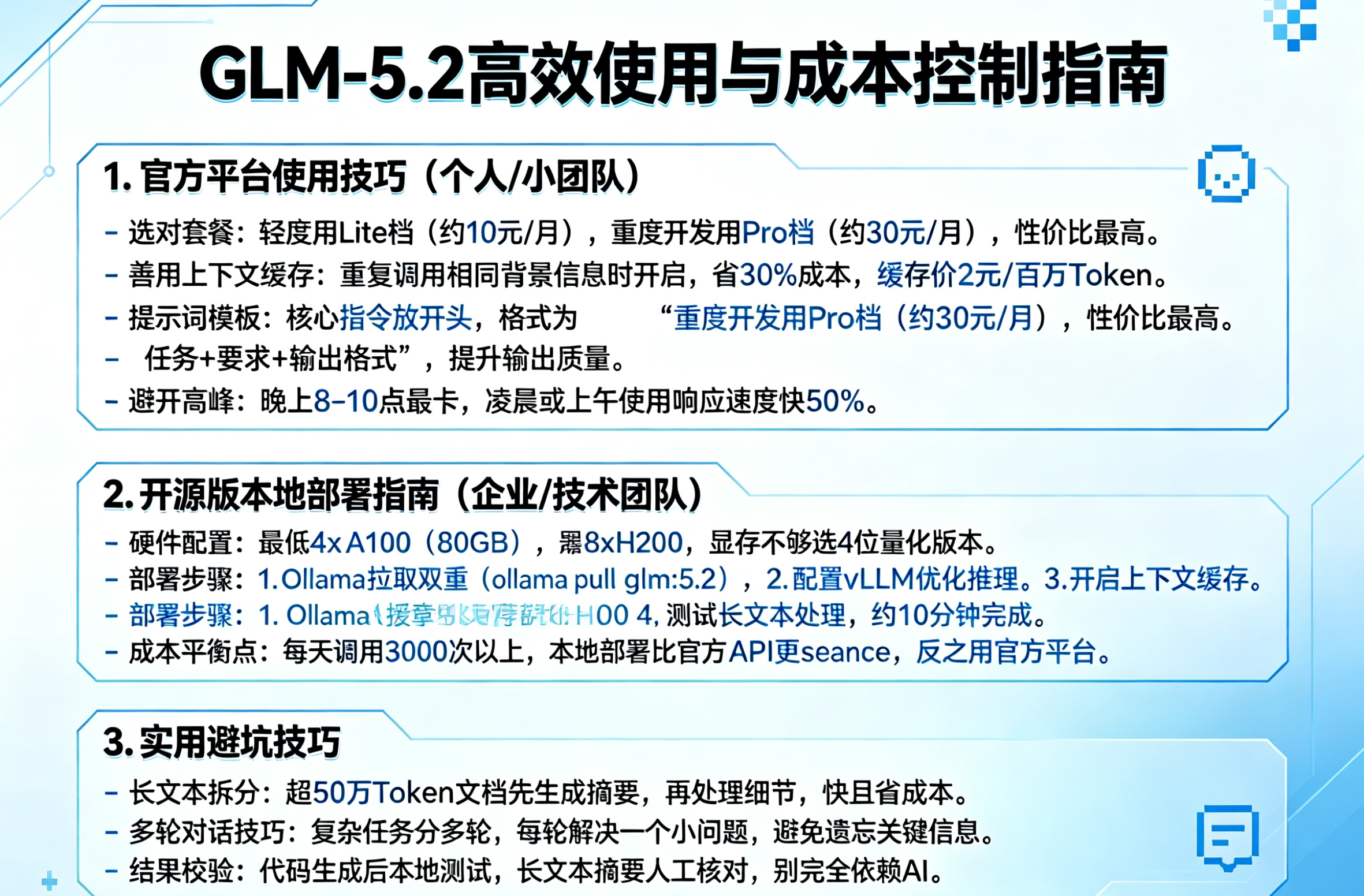
If you decide to use GLM-5.2, this section contains essential tips to enhance efficiency and reduce costs, based on our practical experience.
Official Platform Usage Tips (For Individuals/Small Teams)
- Choose the Right Plan: For light use, select the Lite plan (about 10 yuan/month) for 200 prompts daily; for heavy development, choose the Pro plan (about 30 yuan/month) for 2000 prompts weekly, offering the best cost-effectiveness.
- Utilize Context Caching: When repeatedly calling the same background information, enabling caching can save 30% of costs, with caching priced at only 2 yuan per million tokens.
- Prompt Templates: Place core instructions at the beginning, using the format “Task + Requirements + Output Format,” e.g., “Write an e-commerce backend API, requirements: in Go language, supporting JWT authentication, output format: code + comments + test cases,” significantly improving output quality.
- Avoid Peak Times: The official platform is slowest from 8-10 PM; try to use it in the early morning or during the day for a 50% speed increase.
Open Source Local Deployment Guide (For Enterprises/Tech Teams)
- Hardware Configuration: Minimum requirement is 4x A100 (80GB); 8x H200 is recommended for smooth operation with 1 million contexts. If memory is insufficient, opt for the 4-bit quantization version to avoid OOM errors.
- Deployment Steps: 1. Use Ollama to pull weights (ollama pull glm:5.2); 2. Configure vLLM for optimized inference; 3. Enable context caching; 4. Test long text processing. The entire process takes about 10 minutes.
- Cost-Breaking Point: If calling more than 3000 times daily, local deployment is cheaper than using the official API. Below this frequency, using the official platform is more economical.
Practical Tips to Avoid Pitfalls
- Long Text Splitting: For documents over 500,000 tokens, first have the model generate a summary, then handle details based on that summary for speed and cost savings.
- Multi-Round Dialogue Techniques: Break complex tasks into multiple rounds, addressing one small issue per round to prevent the model from forgetting key information.
- Result Verification: Always test generated code locally and manually verify long text summaries. AI is not infallible; do not rely on it entirely.
Conclusion: Is GLM-5.2 Worth It?
In summary, GLM-5.2 is a specialized tool for text and code, achieving top-tier performance in programming and long text processing. Its friendly open-source license makes it a great choice for programmers, researchers, and enterprise tech teams. However, it may not be cost-effective for creative content creators and general users, who might benefit more from models tailored to their needs.
Its advantages are clear: a million-token context window, top programming capabilities, MIT open-source for commercial use, and high inference efficiency. However, it also has notable drawbacks: no multimodal capabilities, average performance in creative writing, and attention dilution in long texts. When used in the right scenarios, it can significantly boost efficiency; used incorrectly, it can waste time and money.
Finally, we recommend trying the official platform’s free quota for three days, completing tasks relevant to your work, such as writing code or processing long documents, to assess its value before deciding on payment or deployment.
What are you using GLM-5.2 for? Programming, document writing, or research? Have you encountered any surprising or frustrating situations? What do you see as its biggest advantages and disadvantages compared to GPT-4 and Claude? Feel free to share your experiences in the comments, and let’s discuss how to use AI more efficiently!
Comments
Discussion is powered by Giscus (GitHub Discussions). Add
repo,repoID,category, andcategoryIDunder[params.comments.giscus]inhugo.tomlusing the values from the Giscus setup tool.