China’s Largest AGI Infrastructure Financing Announced
On May 7, 2026, it was reported that Wuwen Xinqiong, a leading player in AGI infrastructure in China, has raised over 700 million yuan in financing. This amount not only sets a record for financing in China’s AI native infrastructure sector but also highlights the increasing importance of AI infrastructure as a new value anchor.
In the past three years, capital has focused on model capabilities, but the logic is shifting: the infrastructure supporting the large-scale implementation of models is becoming the new value anchor.
Wuwen Xinqiong, which emerged from the Tsinghua system, has focused on transforming computing power into high-quality tokens since its establishment in 2023. It currently serves several leading model companies, including Moonside and Zhiyu, and has built a technology system based on “diverse heterogeneous + software-hardware collaboration + autonomous AI.”
Recently, during a roundtable at the Beijing Zhongguancun Forum, co-founder and CEO Xia Lixue shared impressive data: since the end of January 2026, the average token call volume on its platform has doubled every two weeks. He remarked, “The last time I saw such a steep growth curve was during the explosion of mobile traffic in the 3G era.”
The financing round for Wuwen Xinqiong features an impressive lineup of investors, including leading firms such as Hangzhou High-tech Investment Group and Huiyuan Capital, along with participation from Guoxing Capital, Qinhuai Data, GF Qianhe, Lihe Qingtong, Zhongbao Investment, AEF NextGen, Tengrui Capital, Kalete, CITIC Capital, and Kuande Intelligent Learning Laboratory, with existing shareholders including Junlian Capital, Shanghai Guotou Futeng, and Yuanzhi Future also increasing their investments.
This collaboration between industry and government sends a strong signal: recognition of AGI infrastructure has evolved from a consensus within the tech community to a consensus within the industrial ecosystem.
Why Independent Infrastructure is Thriving Amidst Major Players
A common viewpoint in the market is that as major companies like Alibaba and ByteDance build their own computing power and model systems, the space for independent AGI infrastructure providers is shrinking. However, the reality is quite the opposite. The AGI infrastructure built by major companies is essentially “self-use infrastructure” tailored to specific business ecosystems, with highly customized architectures, scheduling strategies, and even chip selections. In contrast, the truly public AI infrastructure that can serve diverse models, chips, and scenarios is becoming increasingly scarce.
This explains why independent companies like Wuwen Xinqiong are experiencing a surge in demand. The data reflects this growth: as it announced the financing of over 700 million yuan, the company disclosed that by the end of April this year, the average daily token call volume on its Agentic MaaS large model service platform had increased over 20 times compared to the end of last year, while on a macro level, China’s average daily token call volume has surpassed 140 trillion. This growth trajectory closely mirrors the explosive path of mobile traffic during the 3G era.
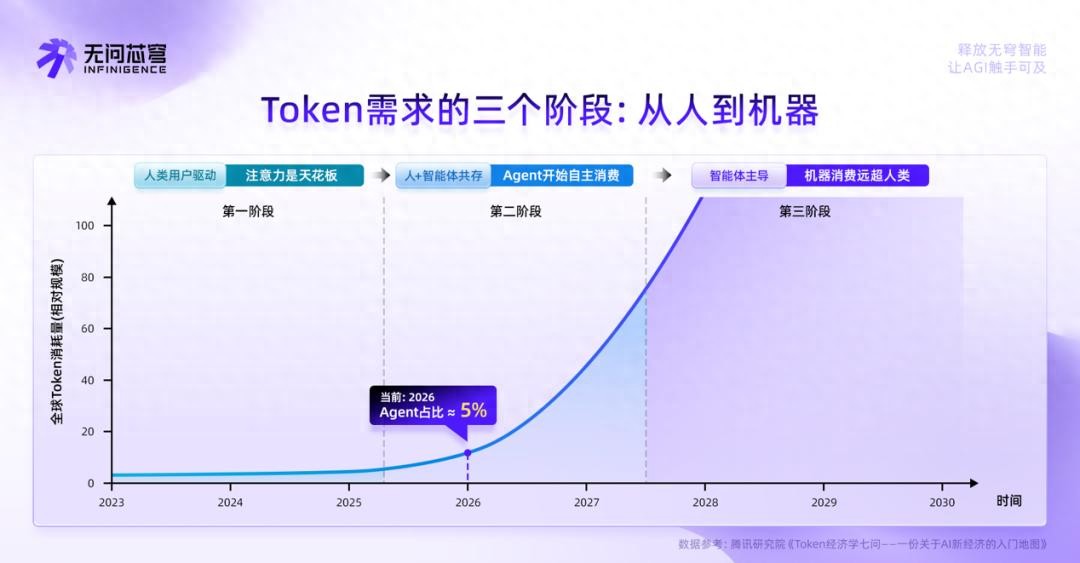
Behind this growth, applications represented by OpenClaw are reshaping demand structures. A complex agent task, such as automatically analyzing a hundred-page financial report or planning an international trip and completing all bookings, can consume token amounts in the tens or even hundreds of thousands per task. Infrastructure is no longer just about supporting model operations; it directly determines the upper limit of AI productivity.
In this context, the value of independent third-party infrastructure has been amplified like never before. As Xia Lixue stated, “Traditional infrastructure is designed for human engineers and programmers, where task initiation takes minutes or even hours. Agents can initiate tasks in milliseconds, and existing systems cannot adapt at all.” This structural mismatch leaves a vast value space for independent infrastructure providers that can be redesigned for the agent era.
Redefining Infrastructure Value: From Computing Power to AI Productivity Formula
At first glance, many might mistakenly believe that the core competitiveness of AI infrastructure companies lies solely in “computing power scale.” This is a profound misunderstanding and one of the industry’s long-standing pain points.
In the past, the quality of infrastructure was measured by simple metrics: how many cards? How fast? This is akin to evaluating a factory based solely on its “power generation” while completely ignoring whether the products it produces are sellable or can fetch a good price.
Now, a more fundamental question is emerging: How much of the tokens produced by computing power are converted into real value?
Wuwen Xinqiong has clearly dissected this value chain: input → electric power → tokens → productivity → value. In this chain, traditional infrastructure only focuses on the first two links—how to produce more tokens with less electricity and faster speed. However, the true bottleneck often lies in the latter two links: How much productivity can these tokens drive? How much commercial value can this productivity ultimately be converted into?
Based on a deep understanding of this pain point, Wuwen Xinqiong has proposed its own solution framework—the AI Productivity Formula:
AI Productivity = Intelligent Scale × Token Production Efficiency × Token Value Conversion
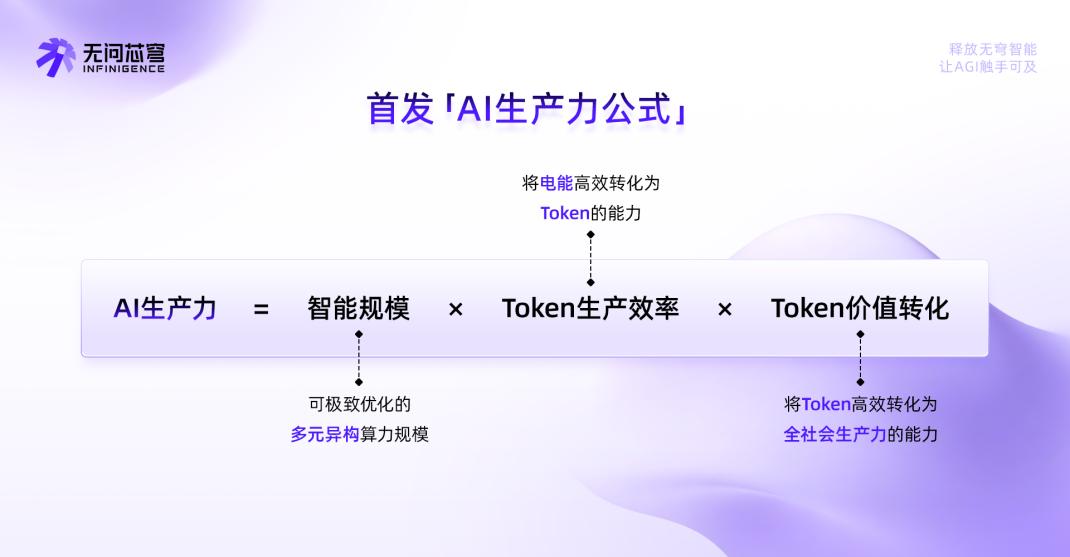
These three factors redefine the value connotation of AGI infrastructure.
Factor One: Intelligent Scale, which depends on the scale of diverse heterogeneous computing power that can be optimized to the extreme through technology. The supply and cost structure of computing power from a single chip manufacturer are currently constraining the process of AI large-scale implementation. Wuwen Xinqiong, with its core technology of “diverse heterogeneous,” achieves extreme optimization across various model algorithms and chip hardware, significantly enhancing the usable scale of computing power and solving the current computing power shortage.
Factor Two: Token Production Efficiency is Wuwen Xinqiong’s hallmark. It has launched a large-scale model training and reasoning integrated platform for AI-native enterprises through its Agentic Infra autonomous AI base, optimizing through software-hardware collaboration and deeply optimizing and jointly designing across software and hardware to maximize chip application computing power.
Factor Three: Token Value Conversion is the crucial leap. A high-quality token, when used for precise prompts or complex task breakdowns, can generate value hundreds or thousands of times greater than low-quality tokens. Wuwen Xinqiong’s platform has integrated leading models, including Kimi, Zhiyu, DeepSeek, Tongyi Qianwen, and MiniMax, further optimizing and leveraging the intelligent limits of trillion-parameter open-source large models, and providing system-level token productivity services to AI-native enterprises, manufacturing, cultural film and television, and intelligent terminal industries.
These three factors together form a closed loop: from energy to tokens, then to productivity and economic value; marking the industry’s competition moving from simple card-stacking contests to a new stage of calculating economic accounts.
This also explains why Wuwen Xinqiong can simultaneously serve leading model companies like Moonside and Zhiyu. When infrastructure becomes a neutral and efficient productivity tool, it often gains the trust of all players due to its pure enabling role.
Who is Betting? Insights into the “All-Star” Investor Lineup Behind the Industrial Ambition
Based on the above redefinition of infrastructure value, capital has begun to recognize the long-term value of this sector.
Wuwen Xinqiong’s financing of over 700 million yuan features an “all-star” lineup of investors, each bringing clear industrial logic.
Firstly, there is the entry of government industrial capital. Local funds represented by Hangzhou High-tech Investment and Huiyuan Capital view AI infrastructure as the “high-speed rail tracks of the digital economy era.” From the perspective of government-side capital, tokens are like electricity and data, essential production factors, and infrastructure determines the efficiency of factor circulation.
Secondly, the involvement of national-level capital. The entry of long-term funds like Zhongbao Investment signifies that the market is beginning to assess AGI infrastructure from the perspective of infrastructure rather than technology projects. This type of capital values not short-term explosions but the long-term compound benefits brought by sustainable tokens.
Additionally, there is industrial capital voting with its feet. The participation of companies like Qinhuai Data and Kalete indicates that infrastructure capabilities are beginning to deeply bind with the real industry. For data center operators, efficient token production capabilities mean higher computing power utilization; for manufacturing enterprises, it means the true activation of data and AI capabilities.
Looking globally, the logic behind this all-star lineup aligns closely with the latest trends in the international capital market. In overseas markets, the Neo Cloud (new type of computing power cloud) sector is rapidly rising.
For example, in the North American AI infrastructure sector, CoreWeave’s market value has quickly risen after its IPO, becoming an important part of AI computing power supply; Baseten’s valuation has increased several times within a year, attracting investments from industry giants.
Global capital has reached a consensus: computing power itself is not valuable; the ability to efficiently convert computing power into tokens is what holds value. As Wuwen Xinqiong’s co-founder and CEO Xia Lixue metaphorically stated, it resembles a “refinery” in the petrochemical industry, transforming raw energy into high-value-added “digital oil”—tokens.
Conclusion: Evolving from the World Factory to the World Token Factory
The previous round of China’s economic growth engine was transforming the cost advantages of manufacturing into “Made in China” export goods. In the new wave of AI, China is establishing a high-efficiency “token factory” by leveraging its energy structure advantages, complete manufacturing system, and strong engineering capabilities.
The successful financing of Wuwen Xinqiong sends an industrial signal: China is evolving from the “world factory” to the “world’s token factory.” By providing high-quality, stable, and sustainable token services, China is capable of contributing a unique and indispensable “Chinese solution” to global AI development.
Comments
Discussion is powered by Giscus (GitHub Discussions). Add
repo,repoID,category, andcategoryIDunder[params.comments.giscus]inhugo.tomlusing the values from the Giscus setup tool.